 Axel Sommer
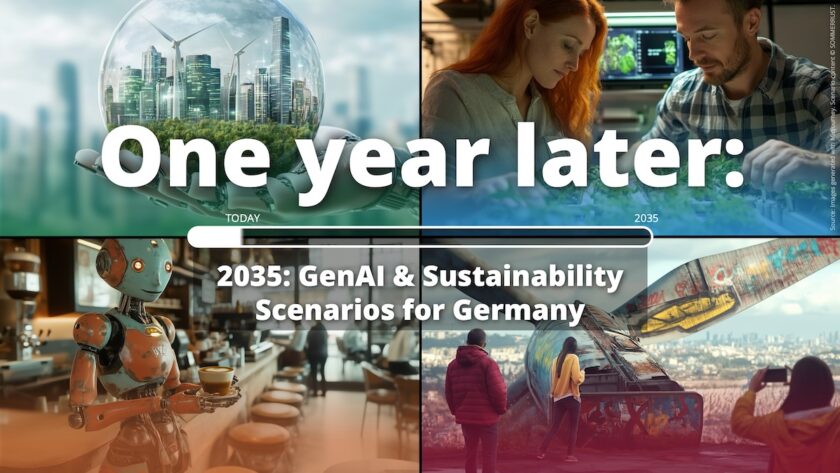
 I revisited the four 2035 scenarios on sustainability and GenAI, originally developed in spring 2025, and compared them with what has actually happened up to May 2026. This was also an experiment: I used OpenAI’s GPT-5.5 for writing this article and the deep research feature for a detailed analysis. Overall, the AI did remarkably well in my view — although some human reviewing and editing was still necessary. This is the result:
A quick reality check one year later
One year is not much in a ten-year horizon. But it is enough to see which early signals are becoming louder.
The strongest signal is not “AI will save us”. It is also not “AI will destroy work”. The strongest signal is that Germany and Europe are increasingly treating sustainability as part of resilience, security and industrial survival.
Pragmatopia: the best current fit
That points most clearly toward the scenario called Pragmatopia: not a green utopia, not collapse, but a resilience-first Germany. Supply chains, raw materials, defence, infrastructure, energy security and adaptation move to the centre. Climate policy does not disappear. It gets reframed.
This is already visible. The EU’s Clean Industrial Deal links decarbonisation with competitiveness. Critical raw materials are increasingly treated as strategic infrastructure. Trade tensions and tariff risks are not background noise anymore; they shape how Europe thinks about industry and sovereignty. Germany’s own debate has also shifted: less “grand transformation”, more “how do we remain functional under pressure?”
But this is not yet the full Pragmatopia. The scenario also included a more participatory and local governance layer: citizens, municipalities and decentralised forums using AI to manage resilience without becoming just a technocratic security state. That part is still much less visible. So Pragmatopia is the best current fit, not a proven destination.
Yes We Can’t: the mood is real
The Yes We Can’t scenario may be the one many people feel most strongly. It describes Germany as moving from one ambitious promise to the next: AI strategies, climate targets, industrial renewal, infrastructure packages — followed by delays, dilution, bureaucracy, lobbying and public frustration. This emotional fit is hard to ignore. Weak growth, slowed emission reductions, and political dissatisfaction make the scenario feel familiar.
But analytically, it is not yet the strongest fit. Things are still being implemented. The EU AI Act is progressing. AI factories and industrial policy programmes are moving. Climate policy has not collapsed. So “Yes We Can’t” captures the mood better than the actual policy machinery.
Ultra-Processed Planet: AI races ahead, sustainability lags
The Ultra-Processed Planet scenario — green growth powered by AI — currently has a different kind of support. It looks more plausible on the technology side than on the sustainability side. Global GenAI capabilities and adoption are moving quickly. German companies are using AI more, and the economic case is becoming clearer. But the broader promise of AI-driven green capitalism remains only partially visible. AI is being used for efficiency, reporting, energy systems and optimisation. Yet it is not obviously stabilising the German economy, nor has it become the main engine of decarbonisation. The technology arc is strengthening; the sustainability and macroeconomic arcs are still lagging.
Ctrl+Shift+Degrowth: crisis signals, but no break point
The Ctrl+Shift+Degrowth scenario currently has the weakest support. Climate stress, trade shocks and economic fragility are real. But the decisive triggers are missing so far: no broad AI-driven mass unemployment, no forced post-growth pivot, no systemic energy crisis caused by heatwaves. Degrowth may still emerge later under severe crisis conditions, but 2026 does not yet look like the beginning of that path.
The real uncertainty is political, not technical
The interesting part is that the biggest uncertainty may no longer be whether GenAI becomes powerful. That seems increasingly likely. The bigger questions are institutional and political1:
- Can Germany turn AI and sustainability into practical resilience rather than another layer of complexity?
- Can Europe avoid reducing climate policy to competitiveness rhetoric?
- Can companies use AI for real operational transformation, not just dashboards and reporting?
- Can AI governance and safety keep pace with rapidly growing capabilities — or will regulation remain one step behind the systems it tries to control?
- Can the labour market absorb AI gradually — or will disruption appear slowly, then arrive all at once?
- And can citizens still experience agency in a system increasingly shaped by algorithms, security pressures and crisis management?
The emerging path: sober, German, unresolved
After roughly one tenth of the scenario horizon, the emerging picture is sober: Germany is not on a clean path to AI-powered sustainability. It is not clearly collapsing either. It is improvising its way into a resilience-first future.
That may be less inspiring than “green growth” and less dramatic than “degrowth”. But it is probably the most German outcome so far: cautious, constrained, technically capable, institutionally heavy — and hoping that pragmatic adaptation will be enough.
The open question is whether “better safe than sustainable” can remain a bridge strategy.
Or whether, by 2035, it becomes the ceiling.
1. I agree with the AI’s assessment with one exception: whether or not AI superintelligence will become technically feasible until 2035. However, this possibility was excluded from the scenario scope as its emergence would dominate everything else.
Note on method and sources: This article is an AI-generated editorial synthesis of the original 2035 scenario material and a subsequent reality check against developments visible by May 2026. It was cross-checked with a longer, AI-assisted deep research report that involved more than 500 web searches; for that research process, the AI was instructed to use only reputable sources (which it mostly adhered to) and to focus primarily on developments after April 2025. The deep research process was conducted several times for comparison. The results were mostly consistent but required careful prompting. For readability, this article does not reproduce the full research trail but was generated separately and cross-checked with the detailed report. Selected inline links were added afterwards as reference points, prioritising official EU and German institutional sources where available and supplementing them with other reputable sources where appropriate. The assessment remains provisional: only about one tenth of the 2025–2035 scenario horizon has elapsed, and the scenarios should be read as plausibility spaces, not predictions.